Simone Cantarini
Pesaro, 1612 – Verona, 1648
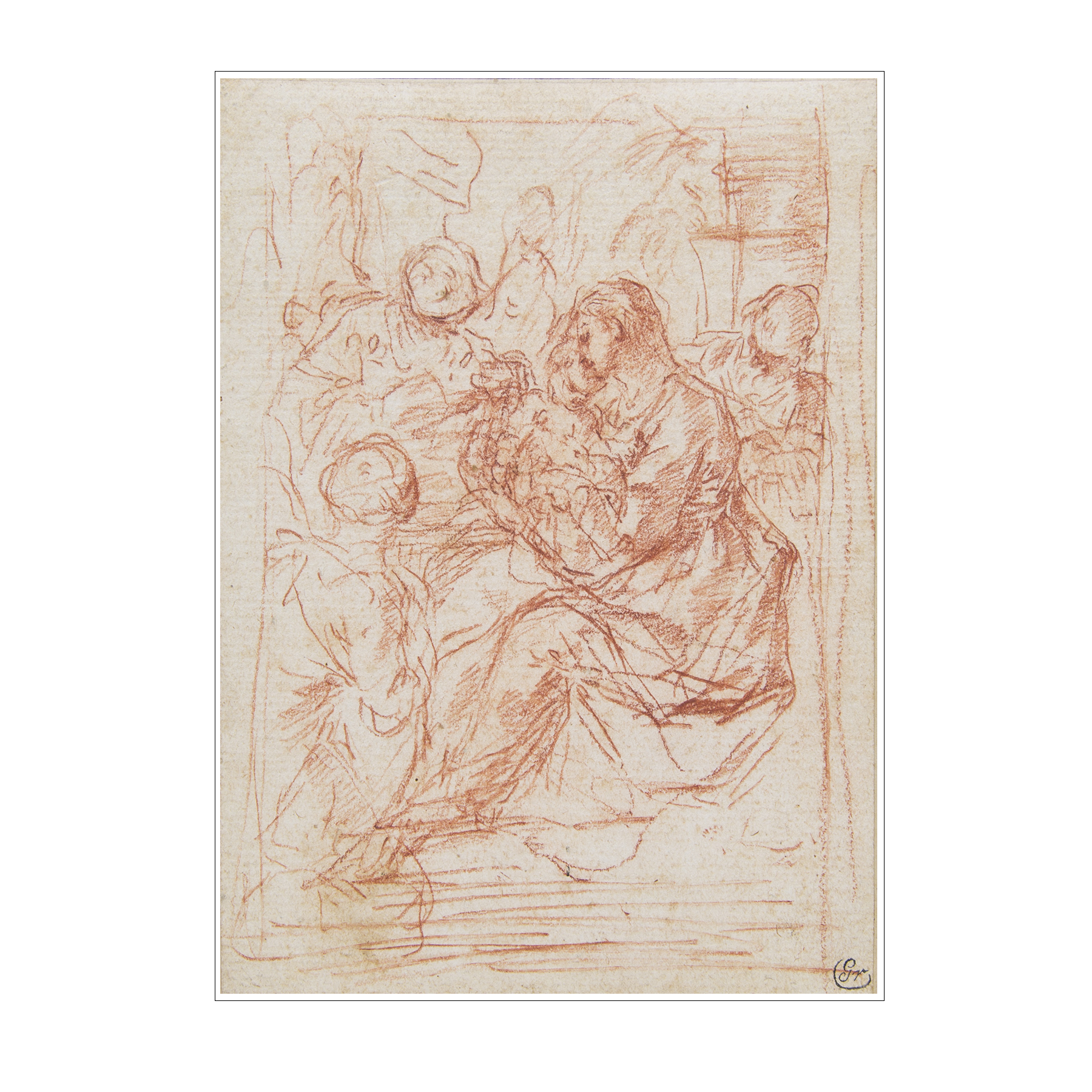
Adoration of the Shepherds or the Magi?
Red chalk on paper
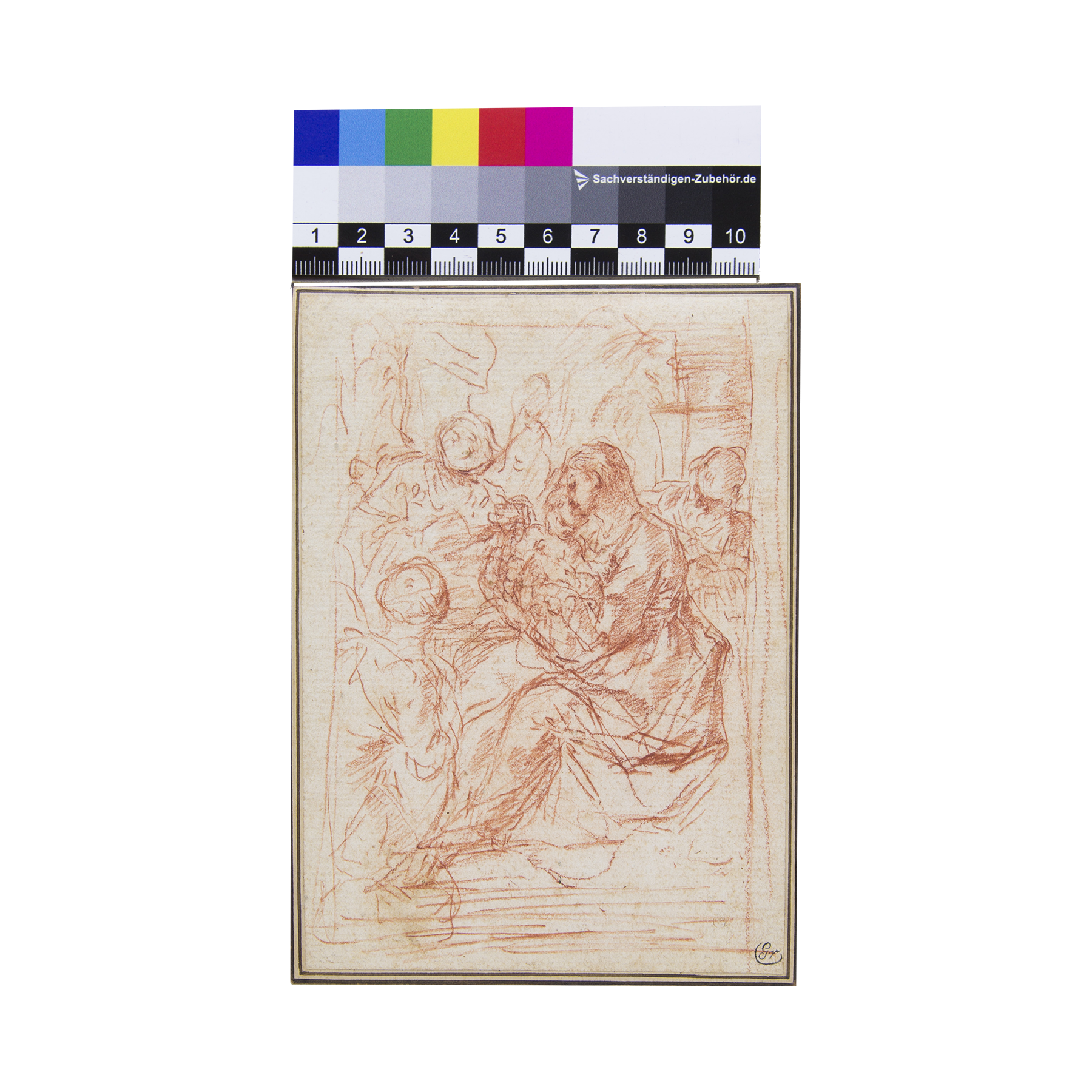
151 x 110 mm
Stamp of Auguste Grahl (Lugt 1199) in the lower right corner
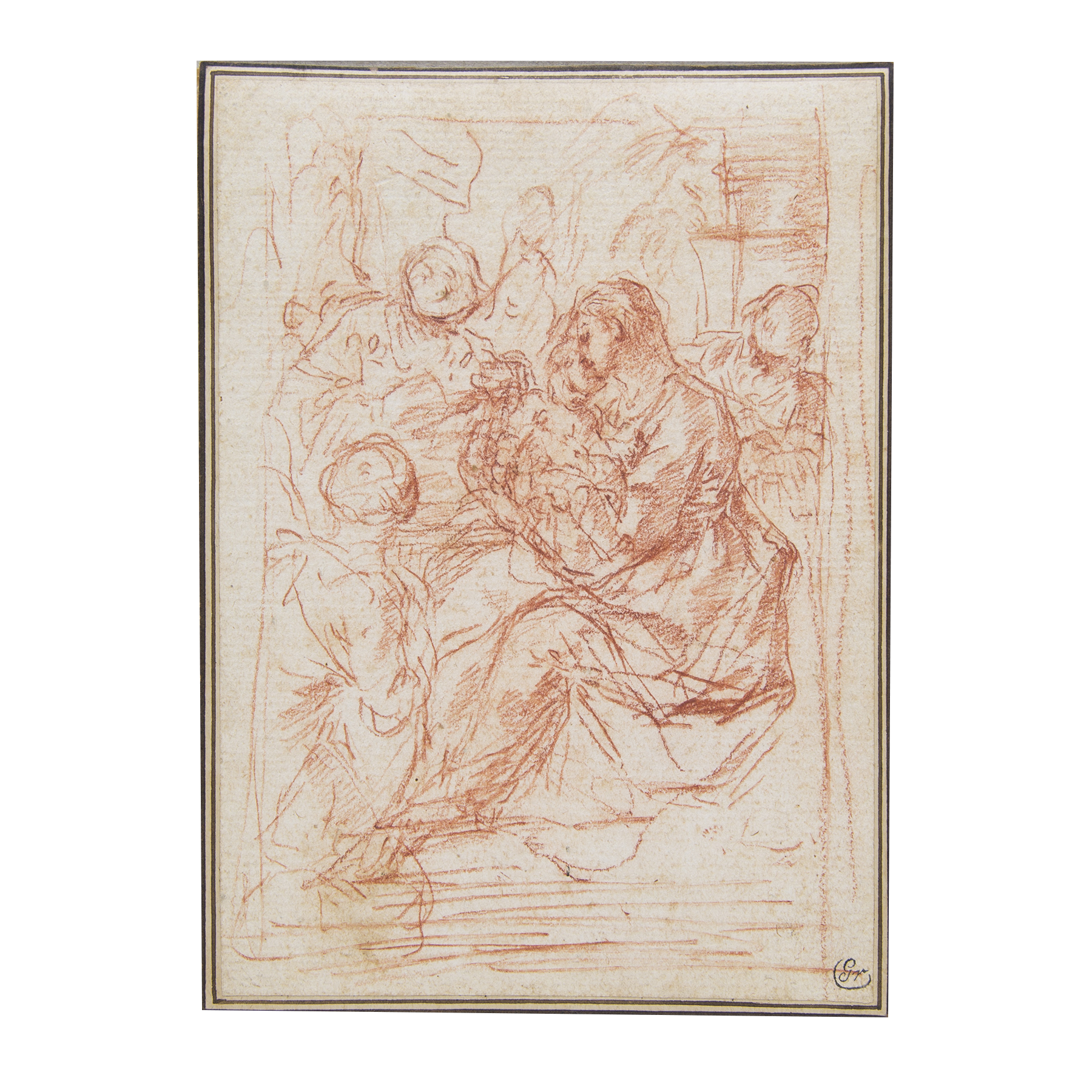
Laid down on a mount with two pen strokes.
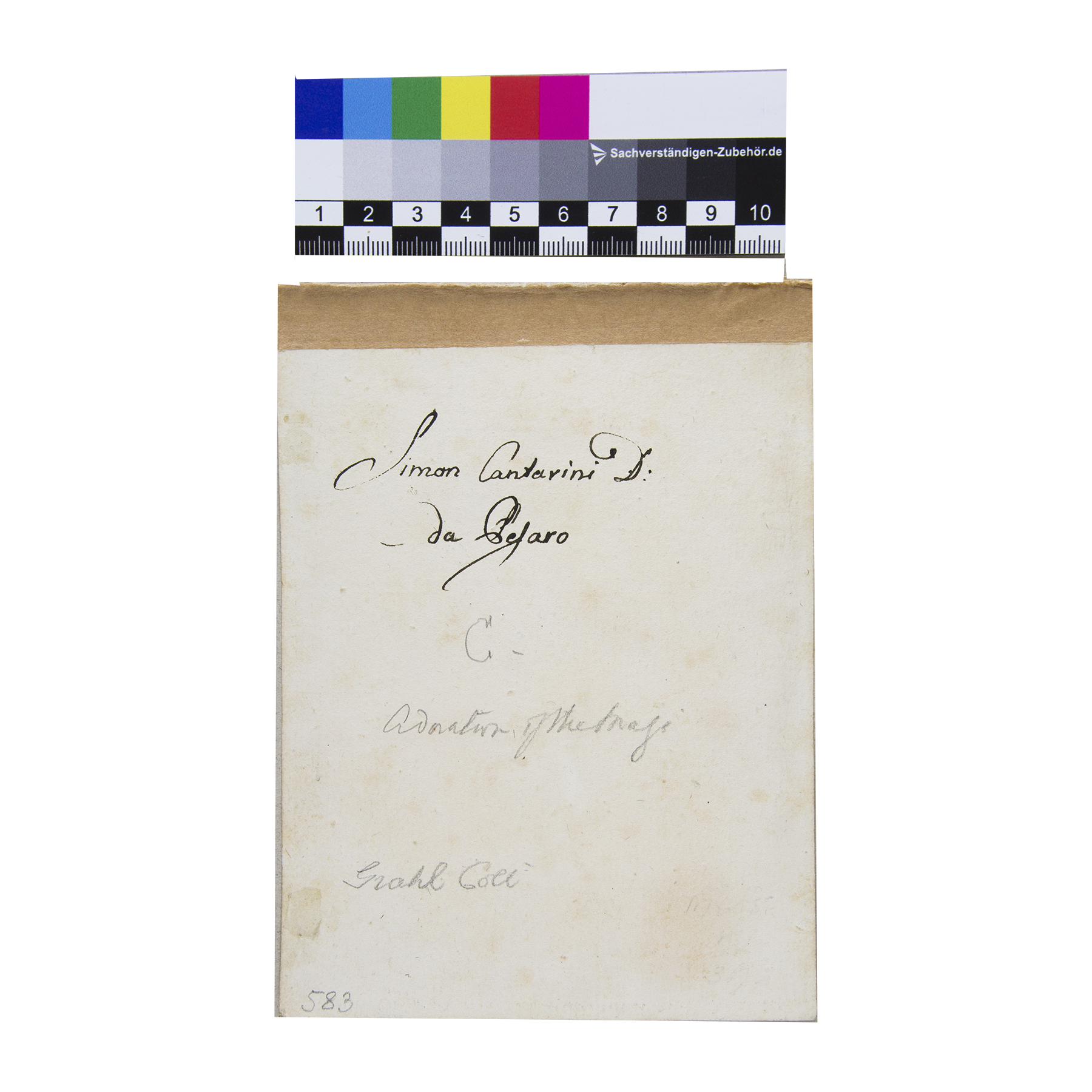
On the reverse of the mount, at the top, in pen and black ink, signed Simon Cantarini D:/ da Pesaro. Below, in pencil in recent handwriting: Adoration of the Magi/ Grahl Coll; and in the lower left corner, numbered 583.
Simone Cantarini, known as “il Pesarese” or “Simone da Pesaro, ” was an Italian painter and engraver of the Baroque period. Trained initially in his hometown, he moved to Bologna, where he joined the studio of Guido Reni; Reni’s influence left a lasting mark on his style, which is characterized by classical grace. However, his relationship with his master deteriorated, and Cantarini left the studio following artistic and personal disagreements. He then developed a personal style, informed by his study of Raphael and Correggio, characterized by the elegance of his figures, the softness of his modeling, and a refined sensitivity to color. A renowned religious painter, he also produced portraits and distinguished himself as one of the great etchers of his time. A prolific draftsman, he left behind a substantial body of red chalk drawings, often related to his religious compositions. Summoned to the Farnese court in Mantua in 1648 to paint a portrait of the duke, he died there suddenly that same year, under circumstances that fueled rumors of poisoning. His body of work, though brief, exerted a notable influence on 17th-century Emilian painting.
Our drawing depicts, in the center, the seated Virgin, draped in a flowing garment, holding the Infant Jesus close to her, surrounded by several figures. In the background on the right, the figure of Saint Joseph appears to be sketched, while the figures on the left—including the one kneeling in the foreground—could represent the shepherds who came to worship the Newborn, or the Magi, as suggested by the annotation on the reverse side of the sheet’s mount: Adoration of the Magi. This sheet is part of the artist’s extensive body of drawings depicting the Holy Families and the Virgin and Child, created particularly after his stay in Rome, where Raphael’s influence is evident in the softness of the facial features and the grace of the poses.
The artist outlines the scene with one or two freehand red chalk strokes, suggesting the frame within which his composition unfolds, a practice found in several of his preparatory drawings, where the outline of the future composition is thus established, even before the figures are arranged (examples: see *The Blessed Virgin and Saint Joseph Gazing at the Child*, Paris, Louvre Museum, inv. 7076, and *Saint Kneeling Before the Virgin and the Infant Jesus on Clouds*, London, British Museum, inv. T,13.16) or once the sketch was completed (see Studies for *The Virgin and Child with Saint John the Baptist and Other Motifs*, Milan, Brera Museum, inv. 501, and Study for an Allegory of Charity and Two Studies of Putti, Milan, Brera Museum, inv. 453)
The drawing takes full advantage of the qualities of red chalk: firm, energetic lines for the outlines, parallel hatching for the shadows, and areas of smudging to suggest the modeling of the drapery. This interplay of tones, ranging from bold lines to soft, blurred tones, is characteristic of this artist’s style. Cantarini quickly sketches the setting, with a column in the background on the right and a fragment of architecture on the left. The figures in the background are rendered in a sketchy, almost rapid-sketch style, while the central group receives a more refined treatment—a common technique for the artist, who thus establishes a hierarchy among the elements of his composition as early as the preparatory drawing stage.
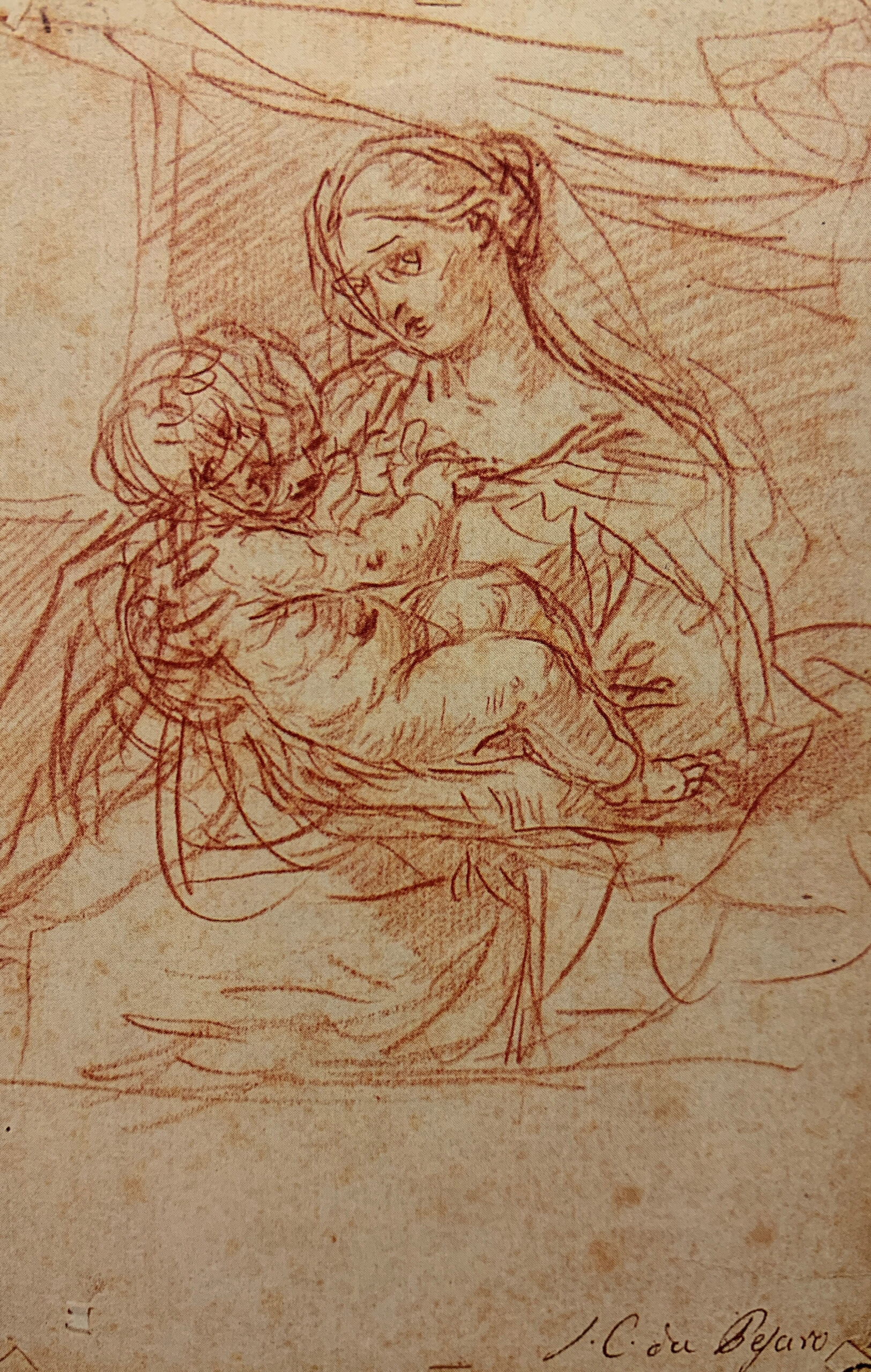 The rendering of the Virgin’s drapery, with its broken folds and intertwining lines at the bottom of the composition, reflects the influence of Guido Reni, while retaining the artist’s characteristic liveliness of line. Through the multiple revisions of the outlines—visible particularly around the heads and hands—Simone Cantarini explores the position of the child in his mother’s arms—an exploration also found in a comparable drawing at the Pinacoteca di Brera in Milan (fig. 1, inv. 99)[1] or in other sketches such as *The Holy Family, Saint John the Baptist with Two Women*[2], *Sacramento*, Crocker Art Museum, inv. 1871.348.
[1] Andrea Emiliani, Anna Maria Ambrosini Massari, and Rafaelle Morselli, *Simone Cantarini nelle Marche*, Venice, Marsilio, 1997, no. 94, pp. 236–2367. On the reverse side of this drawing is *La Madonna della pappa* , a study of the Virgin feeding the Infant Jesus.
[2] Marina Cellini,“Disegni di Simon da Pesaro,” *L’Album Horne*, Cinisello Balsamo, Silvana Editoriale, 1996, pp. 22–23, fig. 3.
Condition: Very good condition.


